
ECONOMIC OPPORTUNITY AND AFFORDABILITY
The Crisis
East Austin was one of the last places where working families could afford to put down roots. Today, that is no longer true. The average home now sells for nearly double what it did just ten years ago. Even though Austin has built more housing in recent years, helping lower rents in many older apartment communities, many newer developments remain out of reach for working families and have not provided enough relief for residents at risk of being displaced from District 1.
At the same time, family incomes have barely kept pace with inflation while housing costs have continued to climb. Together, these pressures have made it increasingly difficult for many families to live, stay, and build a future in East Austin.
The people who built this community—and those committed to its future—deserve the opportunity to remain part of it, and our city's housing policies must move with the urgency this moment demands. East Austin deserves investment and deserves to reap the benefits of it.
What Amber Will Do
Amber will fight for affordability on all fronts because the cost of living in Austin does not boil down to one problem. There are many problems that need to be tackled with a comprehensive, all-of-government approach for District 1.
Amber will pursue every practical solution to make housing more affordable in District 1. She will bring residents, housing advocates, and community partners together to identify common ground and move meaningful solutions forward. Because making housing more affordable requires leadership that can build consensus, foster collaboration, and deliver results.
On Housing
When elected, Amber will champion policies that expand and diversify Austin's housing options, increase opportunities for homeownership, and ensure that growth complements—not compromises—the character of District 1's neighborhoods. That means continuing to improve Austin's permitting and development process, supporting thoughtful land use and zoning reforms, ensuring the city's density bonus programs deliver deeply affordable homes for working families, and strengthening proven programs like Austin's Community Land Trust to help make homeownership more attainable for first-time buyers.
On Utilities
For generations, East Austin has carried a disproportionate share of the city's industrial and infrastructure footprint, leaving many neighborhoods to bear the environmental and health impacts of decisions that benefited the broader region. As Austin continues to grow, Amber believes future infrastructure investments should be planned more equitably, with careful consideration of neighborhood impacts, greater use of clean energy solutions, and a commitment to ensuring East Austin is no longer asked to shoulder an unfair share of the burden. She will also work to strengthen outreach so that eligible District 1 residents are aware of and can easily access utility assistance and energy-efficiency programs that help keep essential services affordable.
On Transit
Getting around Austin without a car is still too hard and too expensive, and it falls hardest on District 1 residents. Amber will fight for expanded, frequent, affordable transit service connecting East Austin to jobs, healthcare, and schools, and will push for Equitable Transit-Oriented Development that pairs new density near transit with guaranteed affordability, not just additional market-rate units.
On Business Opportunity
Amber will expand small business loan programs and push for transparency in the city-owned land to be used for small business incubators and low-cost office space, so that the next generation of East Austin entrepreneurs has a place to start. She will deepen the partnership between Austin Community College, local schools, community-based workforce development partners, and unions to build a skilled trades pipeline that connects District 1 residents to good-paying jobs in the construction and infrastructure boom happening right outside their doors. She will advocate for community benefit agreements and local hiring requirements on any development receiving city subsidies, because economic development that does not employ the people already here is not development for this community.
THE BIG IDEA: Amber will push for a District 1 Economic Opportunity Fund, drawing on city resources and private philanthropy to build a public private partnership as a single coordinated strategy, because affordability and economic opportunity are the same fight.

ADDRESSING HEALTHCARE DISPARITIES
The Crisis
Austin's own public health data makes the problem clear. The 2025 Austin-Travis County Community Health Assessment identified healthcare access gaps, especially in East and Southeast Austin, as one of the city's top challenges, with costs, provider shortages, and transportation all limiting access to care. The need for mental health care in our community is widespread, particularly among youth, caregivers, working families, and lower-income residents. This need is intensified by provider shortages and long wait times, all of which can lead to increases in the unhoused population and contributes to lack of access to resources.
The transportation piece is a significant issue when it comes to access. A 2025 study of hospital access by public transit in Austin found that 160 of 283 census tracts are either partially covered or not covered at all within a one-hour transit trip, and the eastern part of the city has higher proportions of Black, Hispanic, and uninsured residents in those uncovered areas. Texas has the highest uninsured rate in the country. In 2024, 21.6% of Texas adults and 13.6% of Texas children lacked health insurance, roughly double the national rates. Without Medicaid expansion, Austin is left to fill gaps the state and federal government refuse to close.
What Amber Will Do
Amber knows that a city cannot call itself thriving when its own public health data shows whole communities cut off from care. She will act like she always has for the people of East Austin, starting when she helped pass the Affordable Care Act while working as an Obama organizer in East Austin.
On Clinics
Amber will convene leadership across the City, County, Central Health, and other partners to explore effective avenues to bring low-cost and no-cost health services to District 1, with particular focus on primary care, mental health, and reproductive health services. She will push for culturally responsive care and multilingual providers as a baseline, not a bonus.
On Getting People to Care
Amber will partner with Capital Metro and other service providers to expand mobile health programs and transportation assistance mobile health programs and transportation assistance so that homebound individuals, elderly residents, and families without cars can actually reach the care they need. A clinic six miles away, unreachable by transit, is not a healthcare resource for most District 1 families. Amber will treat transportation to care as a healthcare issue. This must also include continued funding for existing city and county programs like the Harvest Trauma Recovery Center and the Hospital Based Violence Prevention programs at Dell Seton that use public health approaches holistically.
On Food as Medicine
Amber will work with private, nonprofit, and business partners to expand access to fresh and healthy food in East Austin's food deserts, using city incentives, land-use tools, and procurement policies to bring full-service grocery options and community food programs to neighborhoods that have gone without them for decades.
On Mental Health
Amber will ensure Austin's mobile crisis response programs are fully resourced to ensure that mental health calls are met by mental health professionals to ensure that members of our community can get connected to the immediate and long term help they need. Amber believes that no child in East Austin should go without mental health care because their family cannot afford it. She will fight to make free mental health services available to every child in District 1 who needs them, partnering with Austin Public Health, Austin ISD, community clinics, Integral Care, and nonprofit providers to build a network of no-cost care that reaches kids in schools, inside community centers, and at home. A child's access to mental health services should never depend on their family's income or their zip code.
THE BIG IDEA: Amber will propose a District 1 Community Health Hub, a coordinated network of clinic access, mobile outreach, food access programs, and the District 1 Youth Mental Health Guarantee, a commitment that every child in East Austin who needs mental health care will be able to get it for free, no insurance required, no waitlist, no exceptions. Healthy communities are not built by accident. They are built by leaders who treat health as a right, not a privilege, and who are willing to put the resources behind that belief.
VIOLENCE PREVENTION & ECONOMIC OPPORTUNITY
The Crisis
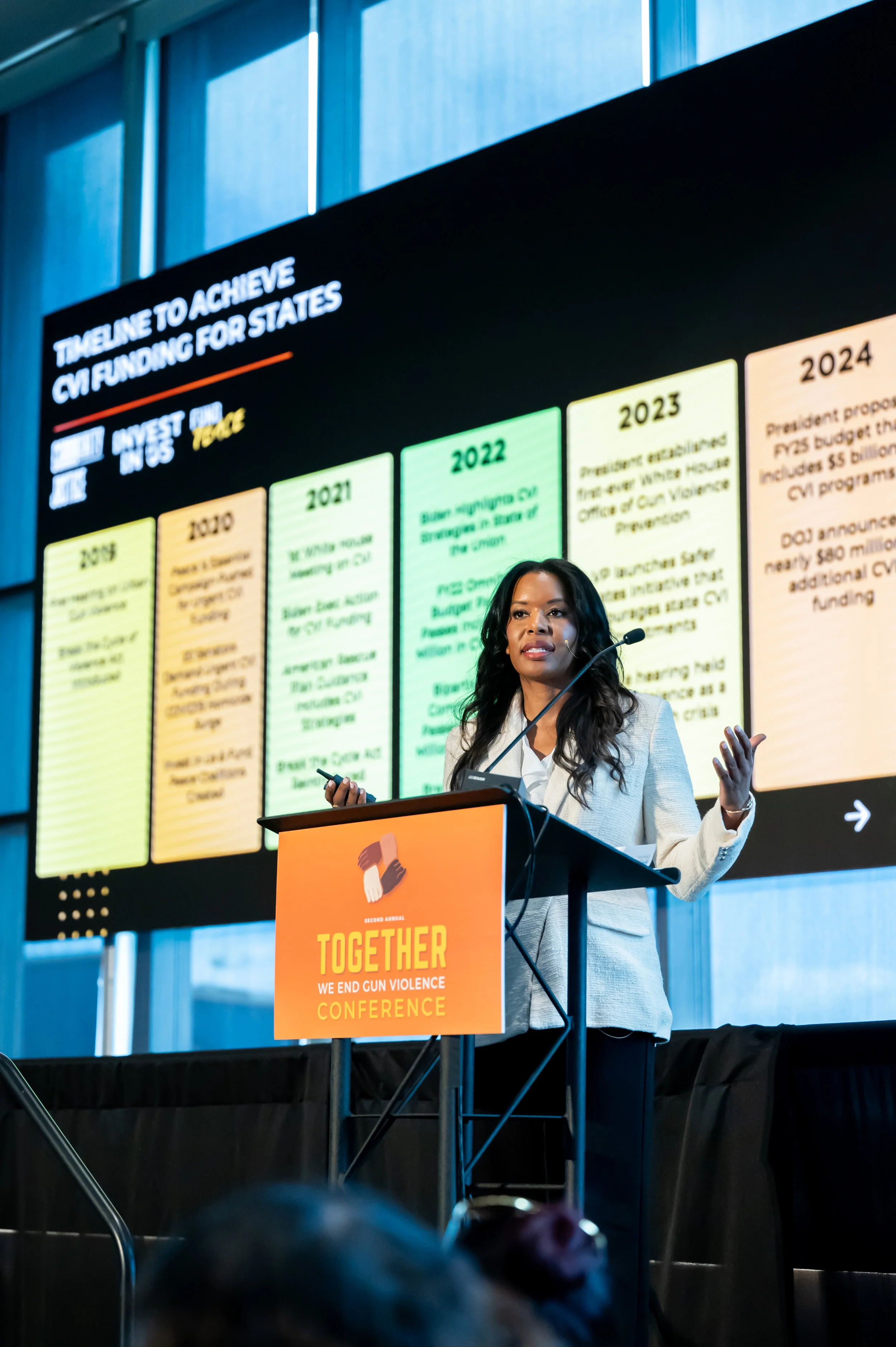
The progress around violence prevention in Austin is real, in part thanks to Amber's leadership on this issue. Austin recorded 55 homicides in 2025, a 25% drop from 2024 and about 60% fewer killings than the record 90 murders in 2021. Community advocates and prosecutors point to expanded investments in community violence intervention programs as a key driver of that decline. This is what prevention looks like when it is funded and it works.
But the work is not done. East Austin accounts for 42% of total homicide incidents in the city. Nearly 32% of homicide victims in Austin are 24 years old or younger, and about half of suspects fall in that same age group. And right now, the federal funding that has driven this progress is under attack. Amber is already in court fighting to protect it.
The research also points to something most people have not yet connected to violence prevention: eviction. The University of Chicago Pritzker School of Medicine found a direct link between eviction rates and gun violence, with every increase in neighborhood eviction rates associated with measurable increases in shootings. Eviction destroys the social fabric that keeps communities safe. Amber will act on that evidence.
What Amber Will Do
Amber is an organizer, an advocate, and an attorney who helped build Austin's prevention infrastructure. On Council she will defend it, deepen it, and expand it.
On Prevention Ecosystems
Amber will protect and grow the Austin Office of Violence Prevention, which she helped establish in 2019 as the first city in Texas with an office dedicated to violence prevention. She will push for sustained funding for community-based violence intervention, reentry services, hospital-based intervention programs, and survivor support services that treat gun violence as the public health crisis it is. Creating a safe, hopeful and healthy public safety violence prevention ecosystem requires that the infrastructure continue to grow.
On Eviction & Housing Stability as a Violence Prevention Strategy
Amber will make eviction interdiction a city priority, working across community service providers, city departments, Travis County, and Justice of the Peace courts to connect families at risk of eviction to legal aid, rental assistance, and mediation before displacement occurs. Keeping families housed is not just a housing policy. It is a violence prevention strategy backed by research, and Amber will govern like it.
When families lose housing, they lose stability, community ties, and access to the services that keep them safe. People experiencing homelessness are significantly more likely to be victims of violence, and the trauma of housing instability ripples through families and neighborhoods for years. Amber will fight for a city response to homelessness that is rooted in dignity and wraparound support, expanding access to mental health services, substance use treatment, and reentry programs that address the root causes of both homelessness and violence.
On Early Intervention
Amber will expand funding for early intervention teams that reach young people before violence does, invest in youth employment and after-school programming as prevention infrastructure, and push for stronger coordination between the city's violence prevention programs, non profits and Austin ISD.
On Parks, Shade, and Public Space as Violence Prevention
When young people have nowhere to go, nowhere to gather, nowhere to just be, the streets fill that gap. Amber has seen it firsthand in East Austin, and she will do something about it.
District 1 is one of the most underserved parts of Austin when it comes to tree canopy and shade infrastructure. While wealthier parts of the city enjoy mature tree cover and well-maintained parks, in places like District 1 heat is a public health issue, and it is a public safety issue. When public spaces are too hot to use, communities lose the gathering places that build the social bonds that prevent violence.
Amber will fight for continued investments that expand tree canopy in East Austin, support revitalizations in places like Walter E. Long Lake, and neighborhoods across District 1.
As a former Division 1 Student Athlete, she will also fight to expand free swimming lesson programs, so that every person has access to water safety education regardless of their family's income. Safe, structured programs like Swim to Code have kept young people connected to caring adults, off the streets during the hours when gun violence is most likely to occur, and invested in a community that is invested in them.
On Federal Funding Defense
Amber is already serving pro bono on the legal team fighting the federal funding cuts threatening prevention programs across the country, including here in Austin. On Council she will be the loudest voice for making sure Austin does not quietly absorb the loss of resources that have driven homicides down 60% from their peak.
THE BIG IDEAS: Amber will push for a District 1 Eviction Prevention and Community Safety Initiative, a bold strategy that can bring together legal aid, rental assistance, violence intervention, and reentry support into a single coordinated response, because keeping families housed, connected, and supported is the most powerful violence prevention tool a city has. She will also push for this as part of a PUBLIC SAFETY DASHBOARD, one that tracks and publicly reports Austin's investment in prevention alongside its investment in enforcement, so that residents can see and hold the city accountable for the full picture of what it takes to keep communities safe.

Help Amber share her story with other Austin community members.